
Use eligible home equity to reduce monthly debt payments
VA Debt Consolidation Loan
A VA debt consolidation loan uses a VA cash-out refinance to replace the current mortgage and pay selected debts with eligible home equity. That can turn credit cards, personal loans, auto loans, and other eligible balances into one mortgage payment.
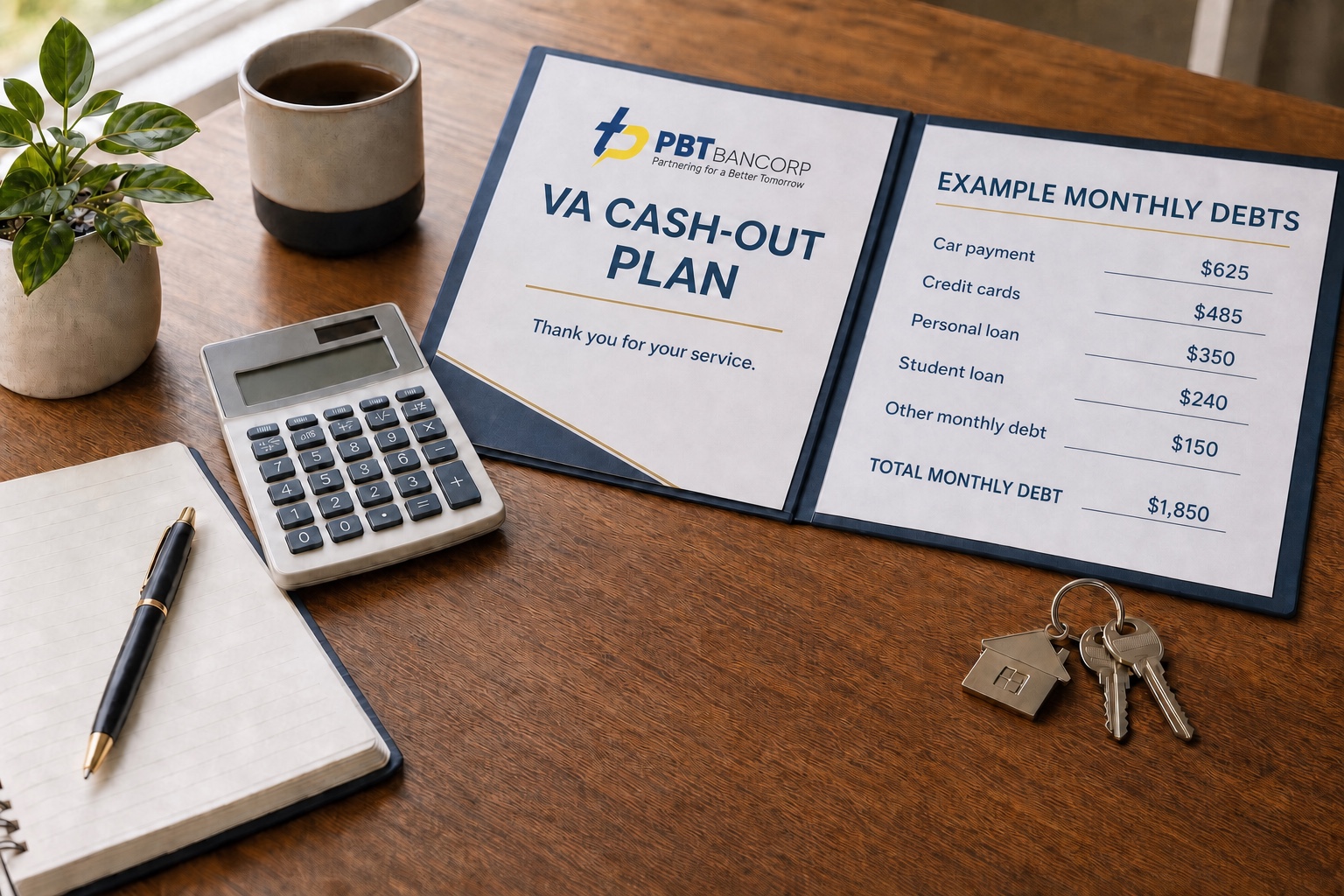
We add the current mortgage payment to every selected debt payment, then compare that total with the proposed VA mortgage payment. When the numbers work, the refinance can lower the amount due each month and create more breathing room in your budget.
- PBT Bancorp NMLS #257781
- FDIC member bank
- Licensed in all 50 states
- One mortgage payment can replace several monthly debts
Want us to look at your VA loan options?
Tell us what you are working on and the best number to reach you. We will call, answer your question, and show you the next step. You do not need a credit check to ask.
What are you trying to do?
Thanks. We will call you back shortly.
Prefer not to wait? Call 888-435-7315.
Can a VA loan be used for debt consolidation?
Yes, a VA cash-out refinance can pay off selected credit cards, personal loans, auto loans, and other documented debts with eligible home equity. The new VA loan replaces the current mortgage and includes the approved debt payoffs in one mortgage balance.
We pull your Certificate of Eligibility (COE), review the appraisal and available equity, and calculate which debts can be paid at closing. The mortgage being replaced can be VA, FHA, conventional, USDA, or another eligible lien. The home must be your primary residence because a VA cash-out refinance cannot be completed on an investment property.
Total monthly debt before and after
How much could a VA cash-out refinance reduce the payments you make each month?
Put the mortgage and the debts you want to pay into one comparison. We can show the proposed VA cash-out payment and the estimated monthly cash-flow improvement.
Which debts can a VA cash-out refinance pay off?
We identify the debts you want paid and request the creditor payoff statements before closing. The approved loan amount and available equity determine which balances can be included at settlement.
Credit cards
Revolving credit cards often create several variable minimum payments. A cash-out refinance can combine approved balances into one mortgage payment, using current payoff statements so the settlement company knows exactly what to send each creditor.
Personal loans
High-payment personal loans can make a cash-out refinance especially useful. We include each balance and required payment in the comparison so you can see the immediate cash-flow difference.
Auto and installment loans
An auto or installment payoff can remove another required monthly obligation. The written comparison lists how much that payoff contributes to the total payment reduction.
Existing mortgage and other liens
The new VA loan pays the current mortgage and required liens first. Approved proceeds can then pay the selected debts, and the comparison shows how each payoff changes the new balance and payment.
How can VA debt consolidation lower monthly payments?
Debt consolidation can lower the required monthly obligations when one new mortgage payment is less than the current mortgage and selected debt payments combined. The monthly difference stays in your budget instead of going to several separate creditors.
At closing, the settlement company uses the approved proceeds to pay the selected creditors. Before you decide, the proposal shows the estimated payment reduction, debts paid, new mortgage balance, and available monthly cash flow.
How do we compare payment relief with long-term cost?
The amount you want to free up each month comes first, then we calculate whether the available equity can create that result through one of our cash-out options.
Current total payment
We total the current mortgage payment and each selected debt payment to show how much you are paying every month before the refinance.
Proposed mortgage payment
Next, we estimate the new mortgage payment, including principal and interest, taxes, and insurance, and identify any debt payments that will remain after closing.
Monthly cash-flow difference
The monthly cash-flow difference is the current total minus the proposed mortgage payment and any debts that remain. That number shows how much room the refinance could create in the budget.
Loan cost and payoff plan
Beside the monthly relief, we show the closing costs, funding fee, new balance, and payoff timeline so the immediate benefit and longer-term cost are both clear.
What could a VA debt consolidation example look like?
In a hypothetical example, a home appraises for $400,000, the current mortgage payoff is $260,000, and selected debts total $38,000. With estimated closing costs and prepaid items of $8,000, the base amount needed would be about $306,000 before adding any VA funding fee. The refinance would pay the selected debts at closing and replace their individual payments with the new mortgage payment.
A 2.15% first-use funding fee would add $6,579 and bring the estimated loan to $312,579, or about 78.1% of the example value. A 3.3% subsequent-use fee would add $10,098 and bring the estimate to $316,098, or about 79.0% of value. Neither fee applies when the COE and VA records show an exemption. This illustration is not a quote or approval because the actual loan depends on the appraisal, payoff statements, costs, entitlement, finances, and maximum loan-to-value we can offer.
How much equity is needed for VA debt consolidation?
Available proceeds are what remain after the approved loan pays the current mortgage, other required liens, financed closing costs, funding fee when applicable, and the debts included at settlement. To establish the maximum loan before calculating the amount for debt payoff, we use the VA appraisal, entitlement, guaranty rules, and PBT loan-to-value limit.
Some PBT cash-out programs can consider a loan up to 100% of the appraised value, while other programs set a lower limit. The percentage alone cannot tell you how much debt can be paid because the current mortgage, other liens, closing costs, and funding fee use part of the approved amount first.
What do the VA funding fee and closing costs add?
Cash-out funding fees are 2.15% the first time you use the benefit and 3.3% on a later use. You do not pay the fee when your COE and VA records show an exemption. Financing it increases both the mortgage balance and payment.
Other costs can include the VA appraisal, title work, recording charges, lender fees, discount points, prepaid interest, taxes, and homeowners insurance. Those charges appear on the Loan Estimate and in the debt comparison. The official VA funding fee and closing cost guidance lists the current federal amounts and exemption categories.
Use the payment relief for a specific goal
Could consolidating the selected debts improve your monthly cash flow?
Enough eligible equity may replace several monthly payments with one mortgage payment. We will show which balances fit, the projected cash flow, and the amount left after closing.
Is a VA cash-out refinance better than a HELOC or personal loan?
Each option changes the first mortgage differently and may use a fixed or variable rate. The comparison includes fees, monthly payments, the home used as collateral, and the expected payoff time for every balance.
VA cash-out refinance
Cash-out refinancing replaces the full first mortgage with one new mortgage. It normally provides a fixed payment, but the new interest rate applies to the entire balance and mortgage closing costs usually apply.
Home equity line of credit
With a HELOC, the first mortgage normally stays in place while a revolving credit line is added against the home. The rate and payment can change during and after the draw period.
Home equity loan
Home equity loans also leave the first mortgage in place, but add a separate installment loan that often has a fixed rate, payment, and repayment term.
Personal loan or credit plan
Unsecured personal loans do not replace the first mortgage or place the new debt against the home, but the rate and required payment may be higher. A nonprofit credit-counseling plan may also deserve review before refinancing the house.
Can a VA Interest Rate Reduction Refinance Loan (IRRRL), often called a streamline refinance, be used to consolidate debt?
An IRRRL is only for an existing VA loan and cannot return home equity for credit cards, personal loans, or other debt payoff. Debt consolidation normally requires a VA cash-out refinance with an appraisal and full review of the income, credit, monthly debts, residual income, primary-residence occupancy, entitlement, title, and property.
When might another debt-payoff option preserve more savings?
Our first goal is to improve the monthly budget while also checking that the payment reduction does not erase a benefit the homeowner already has.
The current mortgage has an unusually low rate
A HELOC or home equity loan may preserve more of the monthly benefit when replacing the entire first mortgage would give up an unusually low rate.
The home may be sold soon
The break-even point shows how many months of payment relief are needed to recover the closing costs and any funding fee before the expected sale.
A large payment is almost finished
Short-term debts can be left out when paying them off would not create enough useful monthly savings.
The monthly budget still needs a plan
The refinance creates the most value when the lower required payments are used to rebuild savings and avoid replacing the paid balances with new debt.
What do we review before recommending debt consolidation?
The first question is how much the combined monthly payment could fall. The appraisal, available equity, credit, and income then determine whether the refinance can deliver that result.
- Current mortgage payoff, rate, payment, remaining term, and loan type
- Balance, rate, required payment, and payoff date for every selected debt
- Estimated value, VA appraisal, lender loan-to-value limit, and available equity
- Credit, income, assets, residual income, debts, occupancy, and property eligibility
- Certificate of Eligibility, entitlement, and funding fee exemption status
- New rate, APR, points or credits, costs, payment, balance, break-even point, and expected time in the home
A complete refinance review
How does debt consolidation compare with other VA refinance choices?
These guides explain the cash-out rules behind debt consolidation, the refinance that does not permit debt payoff, and the funding fee that changes the final mortgage balance.
Cash-out
VA cash-out refinance guide
See how we calculate the eligible equity after the appraisal, current mortgage, other liens, closing costs, and funding fee, then compare the proposed payment with the debts being paid.
Review VA cash-out
Options
Compare VA refinance choices
Compare cash-out with an IRRRL and see why the current mortgage and need for equity decide which program can make the change you want.
Compare refinance options
Streamline
VA IRRRL refinance
If you already have a VA mortgage and do not need equity for debt payoff, see whether an IRRRL could lower the rate or payment without a cash-out appraisal.
Review VA IRRRL
Costs
VA funding fee chart
See the current funding fee for each VA refinance and the exemption categories that can remove the fee from the new mortgage balance.
Review funding fees
VA debt consolidation questions
Is there a VA debt consolidation loan?
A VA cash-out refinance can replace the current mortgage and pay selected debts when enough eligible equity is available. We pull your COE, review the appraisal and finances, and show the debts paid, new mortgage payment, and estimated monthly difference. The VA does not offer a separate personal debt-consolidation loan.
Can I use a VA cash-out refinance to pay off credit cards?
Yes, approved VA cash-out proceeds can pay credit-card balances at closing. We add the current card payments to the mortgage and other selected debts, then compare that total with the proposed mortgage payment. The difference shows how much monthly cash flow the refinance could create.
Do I have to close credit cards after debt consolidation?
Paying a credit-card balance does not automatically close the account, while the approved loan or creditor payoff instructions can require a particular account to be closed. We identify that requirement before the closing documents are prepared.
Can I use a VA IRRRL to consolidate debt?
An IRRRL cannot return home equity for credit cards, personal loans, or other debt payoff. If you want to pay those balances with home equity, we normally review a VA cash-out refinance. That loan requires a VA appraisal and a complete review of your finances, occupancy, entitlement, title, and property.
How much equity do I need for VA debt consolidation?
Available debt-consolidation proceeds start with the VA appraised value and the maximum loan-to-value for the option that fits. We subtract the current mortgage, other liens, closing costs, any funding fee, and other required payoffs. The amount left determines how much of the selected debt can be included.
What credit score is needed for a VA cash-out debt consolidation loan?
The VA does not set one minimum credit score for every cash-out loan, while each lender and program sets its own requirements. Some PBT cash-out options can consider scores as low as 500, and we also review the payment history, income, monthly debts, residual income, available equity, primary-residence occupancy, and property.
Does debt consolidation lower the total amount I will pay?
Debt consolidation is designed to lower required monthly payments, not guarantee the lowest total interest. We walk through the monthly relief, new mortgage costs, and payoff timeline beside the debts being paid.
Is VA debt consolidation better than a HELOC?
One comparison replaces the current mortgage with a VA cash-out refinance. The other keeps the first mortgage and adds a HELOC. The first-mortgage rate, amount needed, closing costs, fixed or variable rate, monthly payments, draw access, and payoff plan can make either choice less expensive.
What happens if I use the refinance and build the credit-card balances again?
You would have the larger mortgage plus the new credit-card balances, which can leave both the required payments and total debt higher than before. A realistic spending and repayment plan should be in place before moving unsecured balances onto the home.
Does the VA cash-out funding fee apply to debt consolidation?
The cash-out funding fee is normally 2.15% for first use or 3.3% for a later use. We confirm through your COE and VA records whether you are exempt. The fee is based on the refinance itself, not the type of debt being paid.
See how much a VA debt consolidation loan could lower your monthly payments
We will add your current mortgage and selected debt payments, then show the proposed payment and estimated monthly difference. You will see which debts can be paid at closing and how much room the refinance could create in your budget.
Last reviewed July 30, 2026.